Towards a New Future Identity of Islam in the Americas
Rooting our Identity in our Collective Past to Create our Collective Futures
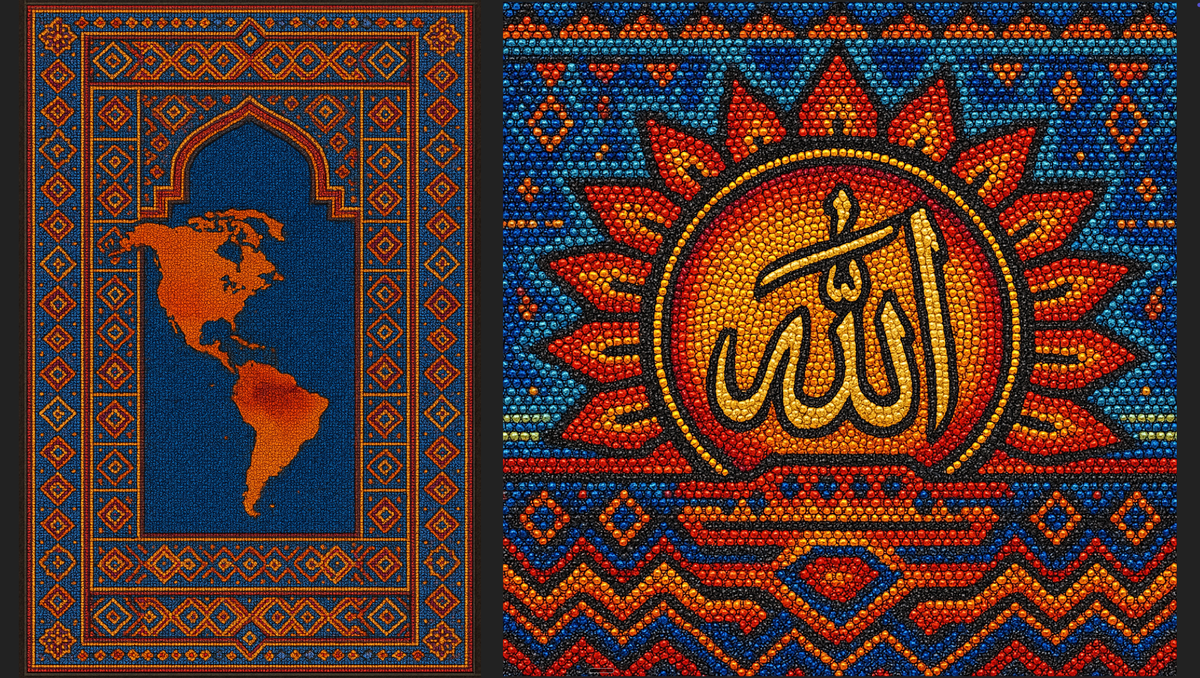
This essay is a part of the Center for Global Muslim Life’s Series - 99 Cities of Global Muslim Impact Building the Future. To Support this work click here. To pre-order the Islam in the America’s Prayer Rug Click Here. This is a draft design inspired by Wixárika indigenous community glass beading art.
The politics of the last 25 years of the war on terror have led to assimilationist narratives within American Muslim communities and other Western Muslim communities, while also seeing the growth of staunch nationalism amongst Muslim populations globally. Although Muslims are expected to continue to grow from one-quarter of humanity to one-third of humanity by 2100, our political power can seem insignificant. Part of that weakness has to do with weak narrative production on our part and a lack of understanding of how narrative change has happened within our communities over decades. This narrative war has been reinforced through multiple channels: media, policy, education, popular culture, and through technological means manipulating search engine, social media, and artificial intelligence algorithms.
A glaring example of these narrative failures is where Muslim narratives clash when immigrant narratives look past the realities of African and African American Muslims establishing Islam in the Americas over hundreds of years of struggle. This is well documented in Sherman Jackson’s classic book, Islam and the Blackamerican. Consider the idea of the “Mother Mosque” in Iowa as supposedly the first mosque in the United States—when in reality there have been hidden mosques and Muslim communities established in these lands for hundreds of years, like the Gullah Geechee communities off the coast of South Carolina and Georgia. This history is only recently being documented in depth by Muhammad Fraser-Rahim in his book Gullah Geechee Muslims in America. As Sylviane Diouf mentioned to us after a talk on her book Servants of Allah: African Muslims Enslaved in America, the establishment of Islam in the Americas by enslaved peoples is grossly under-researched both within academia and by Muslims more broadly.
This erasure serves two purposes. First, it is convenient for immigrant Muslim communities to fall within dominant US historical narratives that prefer to gloss over the series of genocides in the Americas against indigenous peoples and the mass enslavement of African people. This allows Muslim communities to fall within the “nation of immigrants” narrative rather than confront the horrors of settler colonialism and enslavement. Second is the reality of anti-Black racism amongst Arab and broader Muslim communities that do not want to recognize this history as their own. This racism is so pervasive that it doesn’t just impact African and African-American Muslims but also Latino and indigenous converts as well. Until these two failings of our community are rectified, there will be no chance at there being a true Muslim ummah in the Americas.
Our goal with this series of articles on the future of Islam in the Americas starts in our collective past with hopes of beginning to rectify these realities as a form of collective muhasaba (self-reflection) and collective tawba (repentance) that puts our ancestors on the pedestal they deserve for the sacrifices they made in spreading Islam to the last part of the world where our faith had not been previously.
Building a Shared Identity: Lessons from Latinidad
There is much to learn from Latino communities in the Americas who have a collective sense of regional identity through the concept of Latinidad. Our roots are shared through Islam being founded in each of our countries through enslaved and formerly enslaved peoples from Africa. Our Muslim ancestors were at the center of nearly all the revolutions against enslavement—as we will discuss below—fighting for decolonization and freedom on these continents. As the baton was carried from the African to the African American community, we grew a powerful, justice-rooted conceptualization of Islam not only for the Americas but for the world, led by Malcolm X and Imam Warith Deen Muhammad.
Over the last 40 years, these wars of colonization that have impacted every part of these lands native peoples call Turtle Island have now spread to Muslim lands and been perpetuated by the US and Israeli war machines. Muslim families from around the world have moved here now no longer as tech workers but instead as refugees spread throughout the Americas, just as Palestinians moved to the Americas and were accepted after the nakba. As this second nakba has unfolded in Gaza over the last two years, it has been Latin American countries like Colombia under the leadership of Gustavo Petro that have been our greatest allies, as the United States has meandered further down the path of the genocide and fascism it was founded upon. As Muslim communities move throughout the Americas, Islam continues to spread in Spanish and Portuguese throughout Latin American countries at a rapid rate.
So our question then is: How do we take this shared history and build a collective future together? How do we move beyond nationalistic narratives that would place us alongside war machines and instead build toward a future collective identity that takes the baton from our ancestors for a true Islam in the Americas?
Our Revolutionary History
Early Resistance: 1522-1600
Malcolm X is often spoken about as some outlier in his revolutionary beliefs in the history of Islam in the Americas. When the reality is Islam has always been a revolutionary force in the Americas since settler colonialism and enslavement laid the roots of the countries we now inhabit.
As early as 1526, Muslims were banned from entering the Americas when Spanish colonizers created a royal decree banning Wolof people (Muslims from greater Senegambia) from their colonies. This ban came after Muslims created a revolution on Cristóbal Colón’s (Columbus’s) son’s plantation on Hispaniola (Dominican Republic) in 1522, as well as starting revolutions in San Juan, Puerto Rico; in Santa Marta, Colombia; and in Panama.
These revolutions continued as African and African Muslim peoples joined local indigenous communities against the Spanish in Hispaniola, Mexico, Cuba, Panama, Venezuela, Peru, Ecuador, Guatemala, Chile, Martinique, and Florida. This intermixing of African and Indigenous communities was so threatening to the colonizers that they did whatever they could to keep these communities apart over the years. As Sylviane Diouf mentions, there could be entire dissertations looking at primary sources in Spanish and Portuguese throughout the Americas examining how these bans were enforced. Consider the case in 1560 when “the mulatto Luis Solano was condemned to death and the ‘Moor’ Lope de la Peña to life in prison for having practiced and spread Islam in Cuzco, Peru.” Perhaps this was an early convert and a Morisco holding onto Islam in the Americas after the expulsion of their family from Spain, who gave their lives in the name of dawah.
The Age of Revolution: 1791-1835
Despite attempted bans by both Spanish and Portuguese colonies, these revolutions continued to happen with Muslims playing a pivotal role in the Haitian revolution in 1791 and the series of at least 17 uprisings that took place in Bahia, Brazil, led by Muslims from 1816 to 1835. In 1835, a group of nearly 200 Muslims from West African tribes and converts from Angola and the Congo attempted to free their Shaykh Bilal Pacífico Licutan from a Brazilian prison. With this revolution,
“it became clear to white Bahians that, with their schools, books, rings, mosques, multitudes of papers written in a foreign language, anti-death amulets, and religious uniforms, the African Muslims truly constituted an unknown, secretive, mysterious, and dangerous group that had to be completely crushed.”
And so Islam was banned in Brazil again after this revolution in Bahia, and slave owners were given six months to convert the Muslims they were enslaving to Christianity or else they could be fined. Despite this, it was reported in 1869 that a French bookstore in Rio de Janeiro—not exactly the center of Muslim life in Brazil at the time—used to sell at least 100 Qurans a year to Muslims who would keep them in their houses, even long after no one in their families could read it in Arabic.
Parallel Genocides and Epistemicides
Of course, all of this was in parallel to one of the worst genocides in the history of the world perpetuated by the Spanish, the Portuguese, the British, the French, the Catholic Church, and all the colonizing nations and institutions that were a part of what Ramón Grosfoguel calls the four genocides/epistemicides of the long 16th century. Manifest destiny laid the legal and ideological pathway for the colonization of the Americas, the genocide of native communities, enslavement of African peoples, and the banning of all religions that were non-Christian. In the midst of this genocide, in the midst of enslavement, these communities worked together oftentimes to persevere and to keep their religions and cultures alive in the face of absolute tyranny. These bans, in many countries like the United States, continued for Indigenous communities all the way until 1978, when the American Indian Religious Freedom Act was passed.
From Revolutionary Past to Urban Future
This revolutionary history, from the 1522 uprising on Hispaniola to the 1835 Bahia revolt to Malcolm X’s transformative vision, reminds us that Islam in the Americas has never been passive or assimilationist. It has been a force for liberation, justice, and resistance against oppression. As we look toward the future mapped in our 99 Cities of Global Muslim Life project, we must ask: How do we carry forward this legacy?
The demographic projections we’ve developed—showing Toronto reaching 2.2 million Muslims by 2100, the emergence of 10 mega-regions of Islam in the Americas, the 600-1,100% growth in Sunbelt cities—are not just statistics. They represent the unfolding of a story that began with enslaved Muslims keeping the Quran alive in Rio de Janeiro, with African and Indigenous peoples fighting together against colonization, with generations of Muslims building toward liberation.
When we map the future of Islam in the Americas, we are not simply tracking population growth. We are asking: Will these growing Muslim populations in Toronto, New York, Houston, and São Paulo remember the revolutionary tradition they inherit? Will they center the African and African American Muslims who established Islam on these continents? Will they build solidarity with Indigenous peoples and other colonized communities? Will they reject the assimilationist and nationalist narratives that have weakened us, and instead embrace a collective identity rooted in justice?
The cities we document in this series—from the Indo-Caribbean nations facing emigration challenges to the rapidly growing convert communities in Bogotá and Havana, from the established Arab diaspora in Buenos Aires to the emerging Muslim communities throughout Mexico—all exist within this larger story of resistance and survival. Understanding where Muslims will be in 2100 requires understanding where we came from and what we fought for to be here.
This is why our research begins not with demographics but with history. Why we insist on muhasaba and tawba before we project forward. Why we refuse to separate the “objective” work of population mapping from the political and spiritual work of building ummah. The future of Islam in the Americas will be shaped by whether we remember—and honor—our revolutionary past.
This essay is the first in our series on Islam in the Americas, a subset of the 99 Cities of Global Muslim Life project:
- Towards a New Identity of Islam in the Americas (this essay) — Establishing our shared revolutionary history and the need for collective identity beyond nationalist and assimilationist narratives.
- The Mapping of the Future of Islam in the Americas — Geographic distribution, demographic methodology, and the identification of 10 future mega-regions where Muslim life will be concentrated.
- The Top 30 Cities of the Future of Islam in the Americas: 2100/1523 — City-by-city profiles and projections, from Toronto’s emergence as the Muslim capital of the hemisphere to the growth of Sunbelt cities and Latin American convert communities.
- The Cities with the Fastest-Growing Muslim Populations and the Future of Islam in the Americas — Analyzing where growth is happening, why, and what it means for institution-building and community organizing.
Each essay builds on this foundation: that demographic research divorced from historical memory and political clarity serves only to replicate the erasures and hierarchies we seek to overcome. The numbers matter—but only when placed in service of the revolutionary tradition our ancestors established and the collective future we must build together.