Reflections on the Journey to Truth - Malcolm X, Walter Rodney, & Cheikh Amadou Kane
One of the great blessings of my life is that I was guided by the vision of Malcolm X and his belief that we could change the world through a lifelong commitment in the fight for truth and justice. His struggle for racial justice and work for transnational solidarity, his life as a Muslim, and his life as a media theorist impacted me in ways I didn’t fully understand until many years later. I read the autobiography of Malcolm X when I was 20 years old, and within 2 years I was a Muslim. Three years after I read it I became an Ethnic Studies major in College. Within four years I was working in PR and media production, and beginning to think about how to shift narratives. Six years after reading Malcolm I was living in Ghana, studying the history of enslavement in West Africa as I wrote a report on corporate mining colonization by Newmont Mining, a company from my hometown, Denver, Colorado.
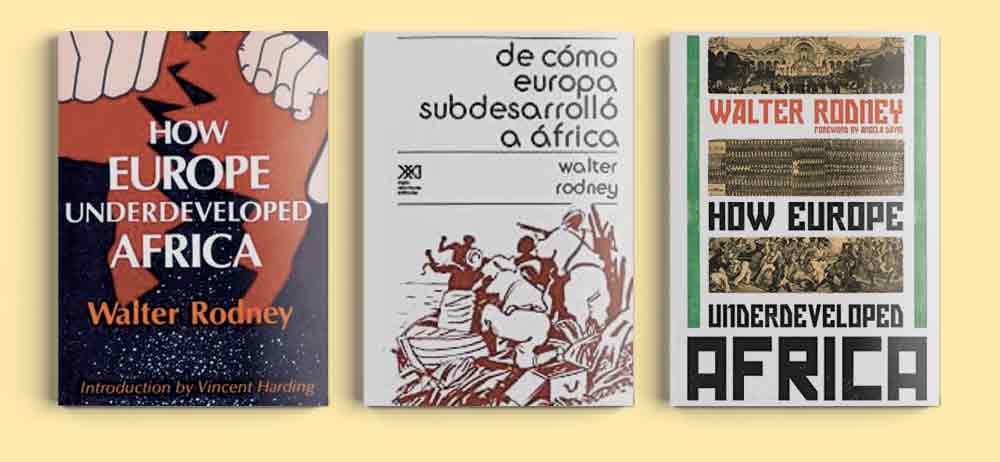
While I was living in Ghana, the true blessing of West Africa and its people allowed me to reflect on my life as a White American in ways I couldn’t have without leaving the country. I also read two of my all-time favorite books that semester I lived in Cape Coast, Walter Rodney’s classic book How Europe Underdeveloped Africa and Ambiguous Adventure by Cheikh Amadou Kane. Taken together these books represent the materialist and metaphysical critiques necessary in understanding the world we inhabit today.
On one side the detailed reality laid out by Walter Rodney in how the 500-year conquest of Africa and the America’s created the world order we live within and on the other the very deep metaphysical reality of what was taken from us in terms of embodied systems of knowledge and lived realities as Muslims. Oludamini Ogunnaike’s article “Of Canon’s and Canons: The Promise and Perils of Postcolonial Education” show us the true brilliance of Kane’s work in laying bare the realities of the colonial education system, as a process of conquering the spirit. As Kane writes with such piercing clarity,
“On the black continent, it began to be understood that their true power lay not in the cannons of the first morning, but rather in what followed the cannons…. The new school shares at the same time the characteristics of the cannon and the magnet. From the cannon, it draws its efficacy as an arm of combat. Better than the cannon, it makes conquest permanent. The cannon compels the body, the school bewitches the soul. Where the cannon has made a pit of ashes and of death, in the sticky mold of which men would not have rebounded from the ruins, the new school establishes. The morning of rebirth will be a morning of benediction through the appeasing virtue of the new school.”
The education system and the propaganda of our 24-7 news cycles are largely to blame for the realities we face in the United States today. A reality that holds up systems of oppression that have kept in place 500 years of racialized capitalist rule that we see falling apart all around us, with only brute force left to keep the system in place. As Muslims even if we are educated at Islamic schools, most of these schools copy and paste the eurocentric and triumphalist curriculums of the public education system with Islamic studies courses sprinkled on top. This is true both in the United States and around the world today.
The time has come for us to imagine new ways of being, new education systems, new economic systems, and a more just form of government that cares for the most vulnerable within our society. These ideas are at the root of what we are building at the Center for Global Muslim Life in imaging the new world that will emerge in the coming years. Our choices right now are clear, we can either imagine a new world and fight for and build a more just future, or we can sit by and watch the world literally burn all around us.
Over the last year since we launched, we’ve been blessed to host more than 55 live sessions, with over 200 speakers from around the world. One of the highlights for me was that we were blessed to be part of a series of conversations with our partners from the Seattle, Washington-based community institution, and Muslim wellness center, Wasat, called, “Breaking the Idols of Our Times.” In the brilliant opening session with Dr. Bilal Ware, “The Way of Iblis, Racist Violence & Capitalist Excess,” he shared a reflection about his time in West Africa that struck me to my core, he stated, of his time there, "It's the only thing that healed me from what this place had done to me. It reconnected me with my fitra." In many ways my time in West Africa saved my life, it surely saved my Islam in what some people call, “the land of the awliya (friends of God).”
As I began my spiritual journey 20 years ago, it was through a radical openness of heart that I was guided to this path. I always say my door was through Malcolm X, and his autobiography, as it has been for millions of people around the world as a true testament to the powerful transformative nature of Islam. In 2002 as I was looking to go deeper I was living across the street from a Buddhist university in Boulder, Colorado. It was there that I bought my first Islamic book, a translation of Ibn Arabi’s Al Futuhat Al Makkiyah (The Openings in Mecca).
Unfortunately, as I was leading protests against the Iraq war, and diving into Shaykh Al Akbar, my local Mosque was steeped in the conservatism of Islam in the United States in the late 1990s and early 2000s that rejected any real teaching or understanding of Islamic spirituality, known broadly in our world as Sufism. I didn’t last at that Mosque long, and like I said my Islam was saved by the balanced understanding of tradition and reality in West Africa and then later in Southeast Asia.
As I moved to California in 2006 to learn from teachers connected to the Islamic tradition of isnad (chains of transmission back to the Prophet saw), I found that our bubble of learning was unique. It was also just that, a bubble, and to see the realities of what Muslims were learning around the world I had to travel. In my experience, there are still places where the tradition is alive, in West Africa, in Southeast Asia (the Nusantara), and where Sufism still plays a central role in the daily life of Muslims. As I’ve traveled the world these years I’ve seen our tasbih’s (prayer beads) replaced with the remembrance of our phones taking up the hands of the people.
Unfortunately, a lot of Muslims who were never given true tastes of the depth of our spiritual tradition in their lives, look for spirituality in other places. This of course isn’t the fault of Muslim youth, we are dealing here with multiple layers of colonization, neo-colonialism, and the policing of Muslim identity. On one hand, is Western colonialism, then we have the neo-colonialism of Islam by petrol dollars and Wahabi / Salafi networks that have in many cases built much of the infrastructure of Mosques and institutions in Muslim minority contexts, like the United States. Add to this, twenty-plus years of the war on terror thought police and the boxes of identity we have all been placed in these decades and you begin to see how complex this all is.
But this pandemic, for all of its difficulty, has also opened people’s hearts and many have reached out wanting to go deeper. I have been blessed to meet my teachers around the world and this is some of what I’ve gathered. My inclinations are towards the Ba’alawi and Qadari traditions, with my teachers Habib Umar Bin Hafiz and Shaykh Muhammad Hydara Al Jilani, but I read broadly within Islamic spirituality.
The greatest difficulty I see with the emergence of YouTube stars and spaces like Clubhouse is that everyone needs a microphone and none of us are taking the time to listen and to truly learn. More than that we don’t take the time to truly go deep within our hearts, to take the time to make dhikr, to make duaa, to perfect our practice and so speaking of Sufism and being of the elect worshipers on the path is difficult when we don’t even understand ihsan within our own practice. Of course, these reflections are focused on myself before anyone else, May God guide and protect us all, and open our hearts to His divine realities, Ameen.